
To stop an emotional affair, stop the private intimacy and contact that are keeping it alive, be honest about what has crossed a line, and make decisions that protect your primary relationship. That sounds simple. It is usually not easy.
An emotional affair rarely begins with a decision to betray a partner. It often begins with a friendship, a private conversation, a person who feels unusually easy to talk to, or the relief of being understood when home feels difficult. The problem is not that another person matters to you. The problem is when that relationship becomes a hidden place for emotional intimacy, romantic energy, or support that belongs inside your committed partnership.
If you are searching for how to stop an emotional affair, you may already know something has changed. You may be hiding messages, minimizing the relationship when your partner asks about it, turning first to someone else with your good news or pain, or feeling a charge around contact that you do not want to name. The way out begins with clarity, not self-punishment.
First, Be Honest About What Has Changed
People often get stuck trying to settle the label before they act. Was it really an affair? Was it only friendship? Did anything physical happen? Those questions can matter, but they can also become a way to avoid the more useful question: Is this relationship taking energy, intimacy, honesty, or loyalty away from my partner?
A friendship has room for daylight. You could describe it honestly. You would not need to erase messages, leave out key details, or tell yourself that your partner is overreacting if they felt uncomfortable. An emotional affair depends on a private world, even if that private world is made of conversations rather than physical contact.
Look for the patterns rather than one dramatic moment. Are you sharing your relationship frustrations with this person in ways you do not share with your partner? Do you save certain stories for them? Do you dress, travel, or arrange your day around a possible interaction? Do you feel disappointed when you cannot talk to them? The answer does not need to condemn you. It needs to tell the truth about the boundary that has moved.
The existing guide friendship or emotional affair? can help put language to that difference. Once you see the pattern, the goal is not to debate it endlessly. The goal is to interrupt it.
1. Stop the Private Intimacy
Emotional affairs are sustained by contact. The texts, private jokes, late-night calls, quick updates, deleted messages, and seemingly harmless check-ins are not neutral when they are feeding a relationship you are trying to end. The first practical step is to stop creating more intimacy.
That may mean ending nonessential contact completely. In a workplace, family, or shared community, total no-contact may not be realistic. Even then, you can make the relationship professional, brief, and visible. Keep communication to necessary topics. Do not meet alone. Do not move conversations to private channels. Do not use your partner's discomfort as a reason to seek comfort from the very person involved.
A clear ending does not have to be cruel or dramatic. It can be direct: "This relationship has crossed a line for me. I am stepping back and will not continue personal contact." Long explanations, emotional goodbyes, and promises to stay best friends usually keep the attachment alive. The person on the other side may be hurt or confused. You can care about that without making it your job to soothe them through the ending.
If you find yourself looking for one final conversation, one last explanation, or one last chance to make sure they understand, pause. The relationship does not become safer because the goodbye has better closure. It becomes safer because the boundary is real.
2. Set a Boundary You Can Actually Keep
Good intentions are not a boundary. "I will try not to text as much" leaves room for the exact pattern that got you here. A boundary names what will change, what you will do when contact happens, and how you will support yourself when the pull returns.
Start with the behavior that most directly feeds the emotional connection. Remove private message threads. Mute or block social accounts if that is what it takes. Change routines that put you in unnecessary contact. If you work together, keep communication on a work platform and copy another person when appropriate. The details depend on the situation, but the standard is the same: the boundary should make honesty easier and secrecy harder.
It can help to tell one trusted person what you are doing. That is not about inviting someone to police you. It is about refusing to let the habit survive in private. If you are in a committed relationship and the affair has affected your partner, the boundary also needs to be clear enough that they can see what has changed.

Boundaries also need a plan for the moments when you miss the connection. You may feel lonely, bored, angry, or suddenly convinced that the friendship was harmless after all. Those feelings are not proof that the boundary is wrong. They are proof that the attachment mattered. Make another choice in that moment: call a friend who supports the boundary, go for a walk, write down what you are feeling, or bring the feeling to your partner or therapist when that is appropriate.
3. Tell the Truth Without Trying to Manage the Outcome
Whether and how to tell your partner is a serious decision. In most committed relationships, a hidden emotional affair is already damaging trust, and ongoing secrecy makes repair harder. Telling the truth can be painful, but it gives your partner the information they need to make their own choices about the relationship.
Honesty is not the same as unloading every thought in a way that creates more injury. It means being direct about what happened, what boundaries were crossed, whether the contact is over, and what you are doing differently now. Do not wait until you have a perfect explanation. Do not offer a partial version in the hope that you can add the rest later. Drip-feeding information usually hurts more than a difficult, honest conversation.
It is also important to own your choices without making the state of the relationship an excuse. You may have felt lonely, dismissed, rejected, or overwhelmed. Those feelings deserve attention. They do not make secrecy inevitable. A more honest statement is: "I was struggling with these things, and I chose to handle them in a way that hurt you. I am responsible for that choice."
Your partner may be angry, devastated, quiet, confused, or unsure what they want. You do not get to control that response. Trying to make their pain smaller so you can feel better turns the conversation back toward you. The work is to listen, answer honestly, and give them room to take in what you have told them.

If there is a risk of violence, coercion, stalking, or fear around disclosure, focus on safety first. The crisis support page has immediate resources. Couples work is not a substitute for a safety plan.
4. Make Room for the Hurt You Caused
After disclosure, many people want to know how to make their partner stop hurting. There is no sentence that can do that. The hurt partner may have questions that repeat. They may go from rage to grief to numbness in a short time. They may question memories, their own judgment, and whether they can trust you again. That is not a sign that they are being unreasonable. It is what can happen when the relationship they thought they understood suddenly feels uncertain.
Making room for the impact does not mean accepting abuse or agreeing to an endless punishment. It means refusing to turn defensiveness into the center of every conversation. When you hear something painful, practice responses such as: "I understand why that would be hard to trust," "I am sorry I put you in this position," or "I will answer as honestly as I can." Those responses do not fix the pain, but they stop adding to it.
Keep your own shame in check. Shame can sound like accountability, but it often pulls attention away from your partner: "I am terrible. You should just leave me." Real accountability stays present. It says, "I did harm, and I am willing to face the impact while I change the behavior that caused it."
This is where a couple can benefit from learning how to handle difficult conversations without either person becoming overwhelmed. Read how to manage emotional flooding and how healthier couples fight for practical ways to pause, return, and stay engaged.
5. Build New Habits of Trust
Stopping the affair is necessary. It is not the whole repair. Trust is rebuilt through a long pattern of actions that are observable, consistent, and freely offered. Your partner needs reasons to believe that your words and your behavior now match.
For a time, that may include practical transparency. Share changes in plans. Be clear about unavoidable contact. Offer information before your partner has to ask for it. Agree together on what access or reassurance would help and revisit those agreements as trust changes. The purpose is not a permanent surveillance system. It is to create enough honesty that your partner does not have to become an investigator to feel grounded.
Small follow-through matters more than dramatic promises. Be where you said you would be. Have the conversation you said you would have. Keep the boundary on an ordinary Tuesday, not only when everyone is upset. Trust grows in the unglamorous moments when someone learns they can count on you.

Repair also includes building a relationship that has more room for honesty and connection than the one you had before. Talk about loneliness, resentment, sex, conflict, friendship, work stress, and the ways each of you wants to feel chosen. Do not use those conversations to explain away the affair. Use them to make a repeat less likely.
The article how to rebuild trust after cheating goes deeper into the longer repair process. The important point here is that trust cannot be demanded on a deadline. It is earned when the person who broke it becomes reliably trustworthy.
6. Get Clear About What Happens Next
Some couples decide they want to repair the relationship. Some decide they do not. Some are not ready to know. An emotional affair does not create one required outcome, but it does require an honest look at the relationship and at each person's willingness to do the work.
Couples therapy can help when both people want to explore repair but keep getting lost in the same painful conversations. It provides structure, helps separate accountability from blame, and gives both people a place to say what is true without turning every discussion into a fight. Couples therapy may be the right next step when you both want to work toward a healthier relationship.
When one partner is not sure they want to stay, pretending that both people are ready for repair can create more pressure and confusion. Discernment counseling is designed for couples who need clarity about whether to work on the relationship or move toward separation.
There is no benefit in rushing your partner to forgive you or rushing yourself to feel certain about the future. The next right step is simpler: end the outside intimacy, tell the truth, keep the boundary, and become someone whose actions are easier to trust.
When Couples Therapy Can Help
Emotional affairs touch the most tender parts of a relationship: trust, friendship, sexual connection, honesty, and the fear of being replaced. Trying to repair all of that alone can feel impossible, especially when one person is deeply hurt and the other is ashamed and defensive. A therapist can help keep the conversations focused, slow down escalation, and make sure accountability does not disappear beneath explanations.
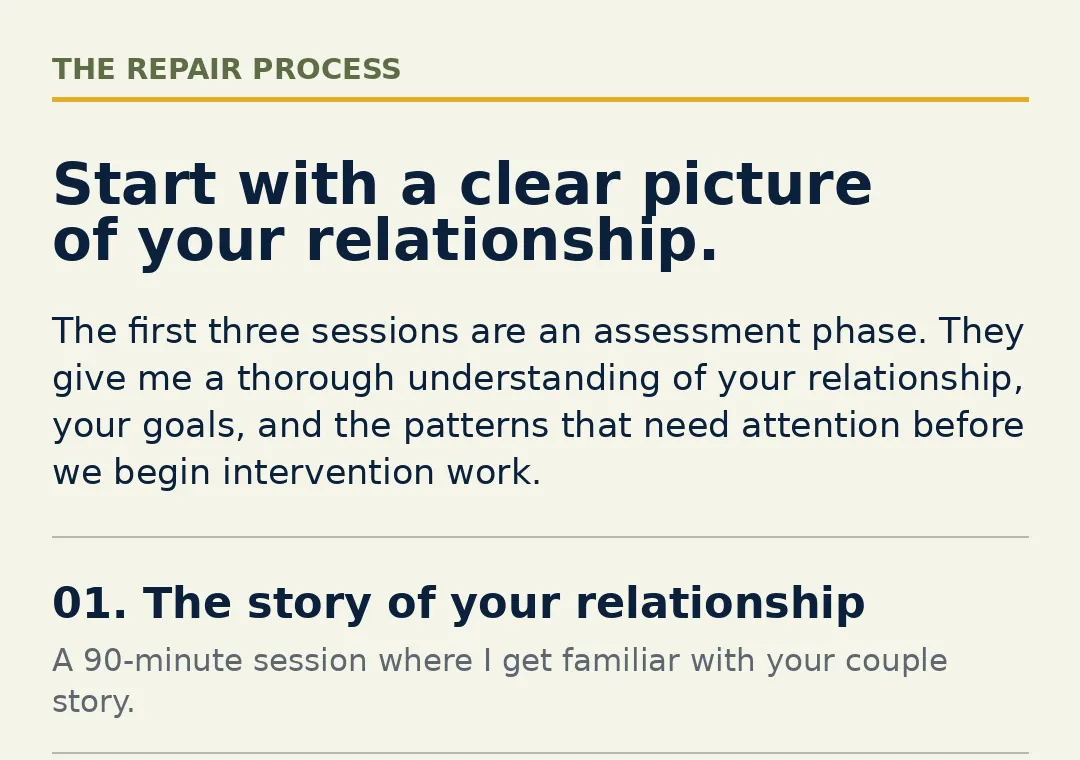
At David Flowers Couples Therapy, the process begins with a thorough assessment and a practical plan for the relationship in front of you. The goal is not to force a particular outcome. It is to help you understand what happened, decide what needs to change, and see whether a more honest relationship can be built from here.
A free fit call is a straightforward first step for Michigan couples who want help deciding what kind of support fits their situation.