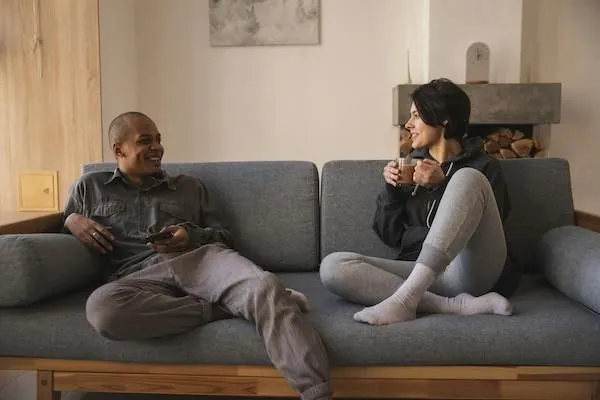

Working on yourself in a relationship does not mean taking responsibility for every problem or trying to become the person your partner wants. It means becoming more able to notice what is happening inside you, take responsibility for your reactions, and bring more honesty and care into the relationship.
Both people still have work to do. But when you stop making your partner responsible for managing your fear, anger, shame, or defensiveness, you create more room for the two of you to understand each other and deal with the real problem together.
I say this carefully, because it's often misused: the single most powerful thing you can do for your relationship is work on yourself.
I say carefully, because this gets weaponized. One partner decides the problem is that the other needs to "work on themselves" and uses that framing to avoid any examination of their own role in the dynamic. That's not what I mean.
What I mean is this: the quality of any relationship is bounded by the individual health of each person in it. You can't build genuine intimacy on top of unresolved trauma, entrenched defensiveness, or the inability to tolerate your own difficult emotions. You can't give from an empty place. You can't be truly present for someone else if you haven't done enough work to be present for yourself.
What Self-Work Actually Looks Like
It looks like developing the capacity to notice what you're feeling before you act on it. Learning to sit with discomfort instead of immediately discharging it onto your partner. Understanding your attachment patterns and how they show up in conflict. Being honest with yourself about where you're operating from fear, from ego, from old wounds that have nothing to do with your partner.
It looks like individual therapy, sometimes. Meditation. Honest reflection. Reading things that challenge you. Having hard conversations with people who know you well and will tell you the truth.
Why This Helps the Relationship
When you do this work, you bring a more regulated, more self-aware version of yourself into the relationship. You're less reactive. You can hear hard feedback without collapsing or counterattacking. You stop needing your partner to manage your emotions for you, which creates space for them to actually connect with you rather than just manage you.
You also model something. When one partner takes their own growth seriously, it almost always has some effect on the other — not because you can change them, but because the dynamic between you shifts when one person changes.
How to Work on Yourself Without Losing the Relationship
Self-work is most useful when it changes how you show up in the moments that matter, not when it becomes another way to avoid a difficult conversation.
- Name what you are feeling before you act on it. If you are hurt, scared, embarrassed, or overwhelmed, pause long enough to identify it. The guide to emotional flooding in an argument can help when your reactions feel bigger than the moment.
- Get curious about the pattern. Ask what you are trying to protect when you get defensive, shut down, criticize, or try to control the outcome. That question can turn a familiar fight into something you can understand.
- Bring the feeling to your partner, not only the accusation. Saying “I felt alone when that happened” gives your partner something real to respond to. The ideas in responding to your partner's feelings can help both of you stay with that conversation.
- Follow through with a small change. Apologize without explaining it away, return to a conversation after a break, ask a sincere question, or do the thing you said you would do. Trust grows from those ordinary moments.
When Working on Yourself Is Not Enough
Personal growth can change the tone of a relationship, but it cannot make a relationship healthy by itself. If the same conflict, distance, or broken trust keeps returning, both partners may need a structured way to work on it together. Couples therapy can help you understand the pattern between you, practice a different response, and build a clearer way forward.